SIES — Shape Identification in Electro-Sensing
SIES is a Python library for inverse problems in electro-sensing: it simulates electric measurements of small inclusions, computes their Generalized Polarization Tensors (GPT), and identifies or tracks targets from noisy data.
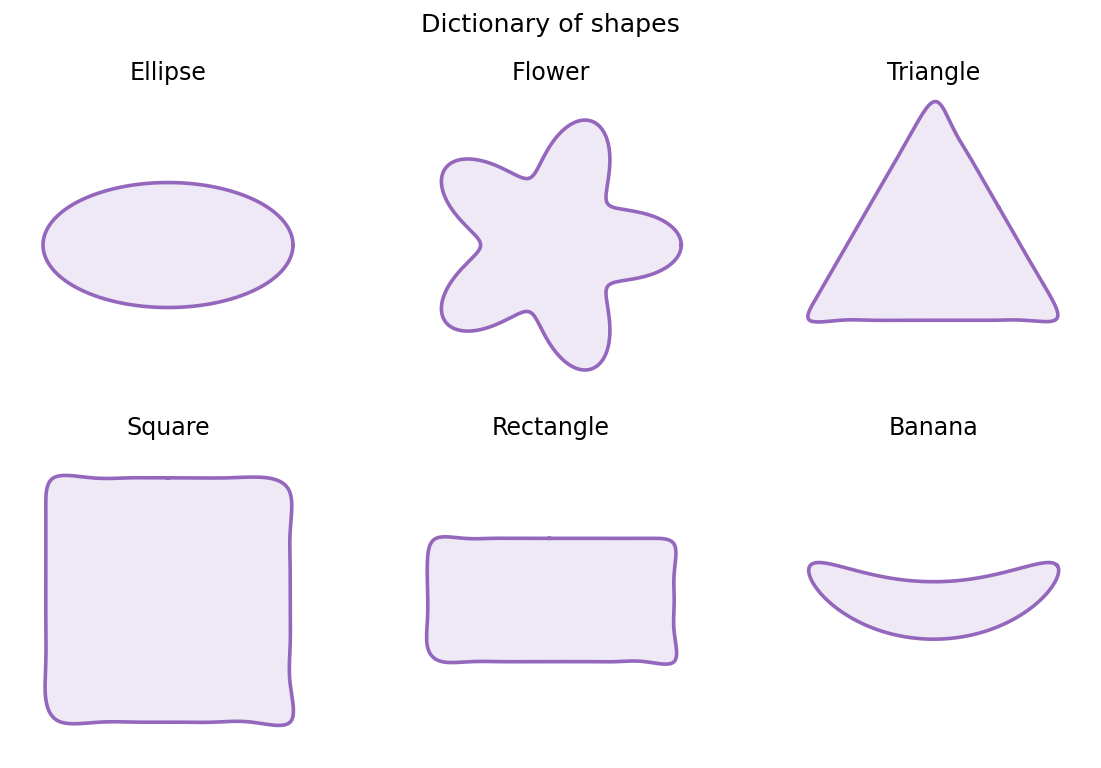
What can it do?
- Shapes — discretized \(C^2\)-smooth boundaries (ellipses, flowers, triangles, rectangles, bananas) with exact differential geometry and rigid motions.
- Layer potentials — boundary integral operators of potential theory: single layer \(S_D\), Neumann–Poincaré \(K_D^*\) and their derivatives.
- CGPT — contracted generalized polarization tensors, computed numerically for any shape and analytically for disks and ellipses, with their exact transformation rules under translation, rotation and scaling.
- Forward problem — multistatic response (MSR) matrices of the conductivity equation, at one or several frequencies, with calibrated noise.
- Inverse problem — least-squares and closed-form reconstruction of the CGPT from MSR data.
- Dictionary matching — invariant shape descriptors and identification of an unknown target in a dictionary of shapes.
- Tracking — Extended Kalman Filter estimating the position and orientation of a moving target.
Quick example
import numpy as np
from sies.shapes import Flower
from sies.acquisition import Coincided
from sies.pde import ConductivityR2

# A flower-shaped inclusion and a circle of 100 coincided sources/receivers
target = (Flower(1.0, 1.0, 256) * 0.5) + np.array([0.2, 0.1])
cfg = Coincided(np.zeros(2), radius=1.5, nb_src=100)

# Simulate the multistatic response and reconstruct the CGPT
pde = ConductivityR2(target, cnd=3.0, pmtt=0.0, cfg=cfg)
data = pde.simulate_data(freqs=0.0)
result = pde.reconstruct_cgpt_analytic(data.msr[0], order=5)
Head over to Getting started for a complete walkthrough, or browse the API reference.
References
The library reproduces numerical results from:
- Ammari, Boulier, Garnier, Kang, Wang, Target identification using dictionary matching of generalized polarization tensors, Foundations of Computational Mathematics, 2014.
- Ammari, Boulier, Garnier, Jing, Kang, Wang, Tracking of a mobile target using generalized polarization tensors, SIAM Journal on Imaging Sciences, 2013.
- Ammari, Boulier, Garnier, Wang, Shape recognition and classification in electro-sensing, PNAS, 2014.
Credits
Python port of the original MATLAB library by Han Wang.